
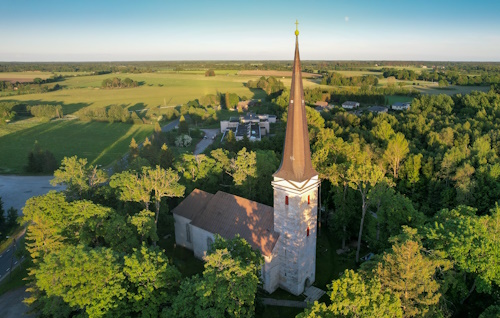
Welcome to Lääne-Nigula Church
The Church of St. Nicholas in Lääne-Nigula is one of the oldest churches in Läänemaa (Western Estonia). The present single-nave Early Gothic stone church was built in the second half of the 13th century, following the building traditions of the Diocese of Saare-Lääne. The church is dedicated to St. Nicholas, from whom the name Nigula is derived. Before the stone church was erected, a small wooden church stood on the same site.
The church was built of local limestone quarried at Kabelimägi in Kirimäe.
In 1809, the church was devastated by a great fire. The tower spire, roof, vaults and most of the interior were destroyed, leaving mainly the stone walls standing. Because of the war, the reconstruction was delayed, and the church was not reconsecrated until 1816. For this reason, the present interior is considerably younger than the medieval walls surrounding it.
Three magnificent wooden sculptures from the church’s medieval Late Gothic winged altar have survived. They depict St. Nicholas, the Virgin Mary with the Christ Child, and St. John the Evangelist. Today, these sculptures are preserved in the Niguliste Museum in Tallinn. The altar was most likely produced in the workshop of the Lübeck master Hennig von der Heyde, demonstrating that even rural churches in medieval Estonia maintained connections with Europe’s leading artistic centres.
The present altar was completed in 1823 and was most likely made by the St. Petersburg master Sigismund. This four-column Classical-style altar was transported from St. Petersburg in sections and assembled inside the church. The altar paintings were donated by the local landowner Aderkas. The lower painting depicts The Last Supper, a copy of Leonardo da Vinci’s famous work. The upper painting, The Resurrection, is believed to be a reproduction of a painting by Charles-André van Loo.
A major restoration of the church took place in 1882–1883. The roofs were renewed, a gallery was built, a new elegant tower spire was erected, and a lightning conductor was installed. The church’s present exterior largely dates from this restoration. The necessary funds were raised through donations from local people, fairs and lotteries.
The church has continued to be carefully restored throughout the 20th and 21st centuries. The interior walls and pews have been renovated, a new heating system was installed with the support of the parish’s friendship congregation in Raahe, Finland, a new floor was laid, and in 1995 the church received stained-glass windows designed by students of the Estonian Academy of Arts. In 2023, the heating systems of both the church and the parsonage were modernised and replaced with a ground-source heat pump system.
The church tower was completed in 1760, and the year of its completion can still be seen on the exterior wall beside the main entrance. The tower stands 52.2 metres high, of which the spire measures 26.7 metres.
During the restoration of the tower in 1994, a newspaper dating from 1882 was discovered inside the tower’s finial sphere—a small time capsule from the previous major renovation. Originally, the tower was covered with wooden shingles, but since 1995 it has been clad in copper sheeting. The tower staircase and viewing platforms were renovated in 2024.
The tower houses two church bells. The larger bell bears the inscription “Come home, you sinners!” It was donated by local peasants, while the smaller bell was commissioned by the local manor owners.
The church is surrounded by an ancient cemetery. Archaeological excavations have shown that the burial site was already in use before Christianity reached Estonia. It is believed that this ancient sacred site was one of the reasons why the church was originally built here.